Oakville Real Estate Update 2026: March Trends & Spring Market Forecast
Sales Rise in March Despite Declining Consumer Confidence
The outbreak of the Iran conflict caused already fragile consumer confidence to weaken during March. While housing sales increased slightly from last year, geopolitical instability, financial market volatility, surging gas prices, and rising fixed-term mortgage rates all contributed to keeping activity well below normal. Despite less supply on the market as sellers became hesitant to list properties, prices continued to fall on an annual basis.
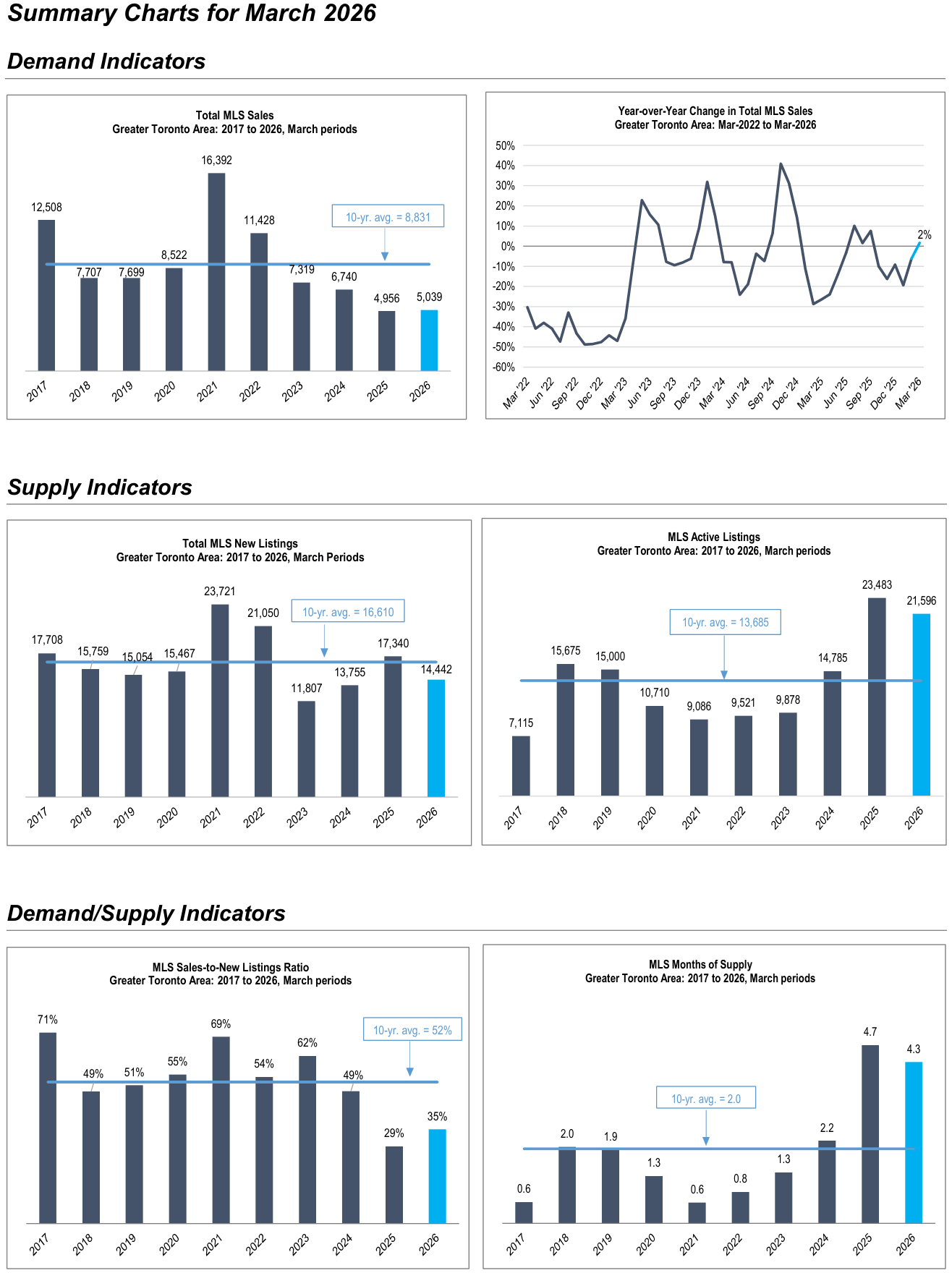
Sales Increase for First Time in Six Months: Total MLS sales in March increased 2% from a year ago to 5,039 homes, the first year-over-year increase in six months. However, it was the second lowest March total of the past 30 years, with activity 43% below the 10-year average. For Q1 as a whole, sales were down 7% from last year.
New Listings Fall for Third Straight Month: New listings dropped for the third straight month, falling 17% annually to 14,442 homes in March — 13% below the 10-year average. As a result, active inventory declined 8% from last year to 21,596 units, which was still the second-highest level since 2009 and 58% higher than the 10-year average.
Inventory Declines to Four Months of Supply: Market conditions improved during March while remaining soft from a historical perspective. The 35% ratio of sales-to-new listings rose from 29% last year, which was still well below the 10-year average of 52% and a balanced market range of 45-60%. Months of supply declined to a 15-month low of 4.3 months, a sharp decrease from the recent high of 5.8 months in January, but still more than double the 10-year average.
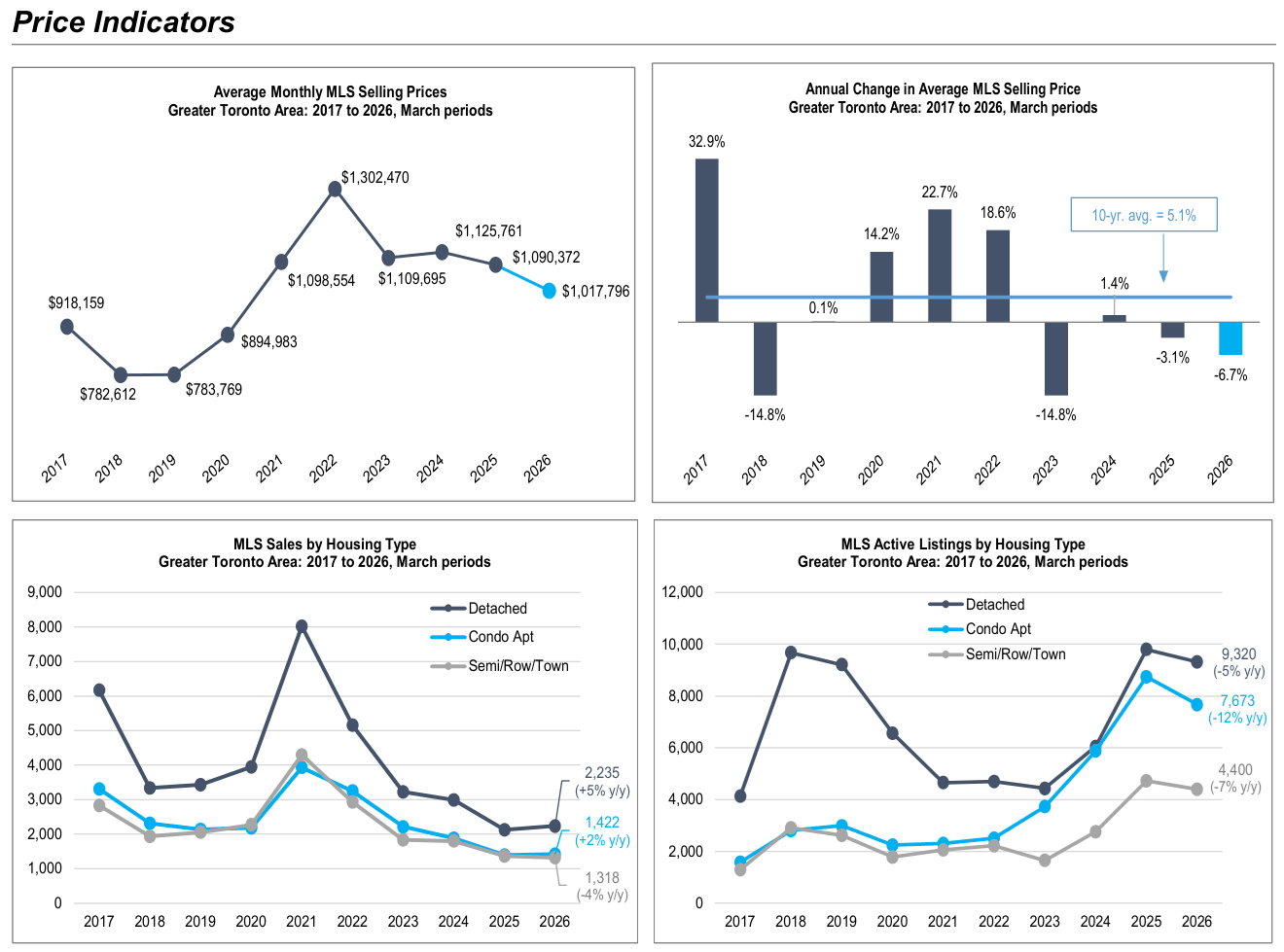
Prices Decline Annually for 14th Straight Month: The improvement in market conditions helped sellers in price negotiations during March. The ratio of average sale price-to-list price increased to a nine-month high of 98%, with average prices moving up 0.9% month-over-month. On an annual basis, average prices declined for the 14th consecutive month, down 6.7% to $1,017,796. Despite average prices being down 22% over the past four years and falling to their lowest March level since 2020, annual growth averaged 5.1% during the past 10 years.
Sector & Regional Analysis
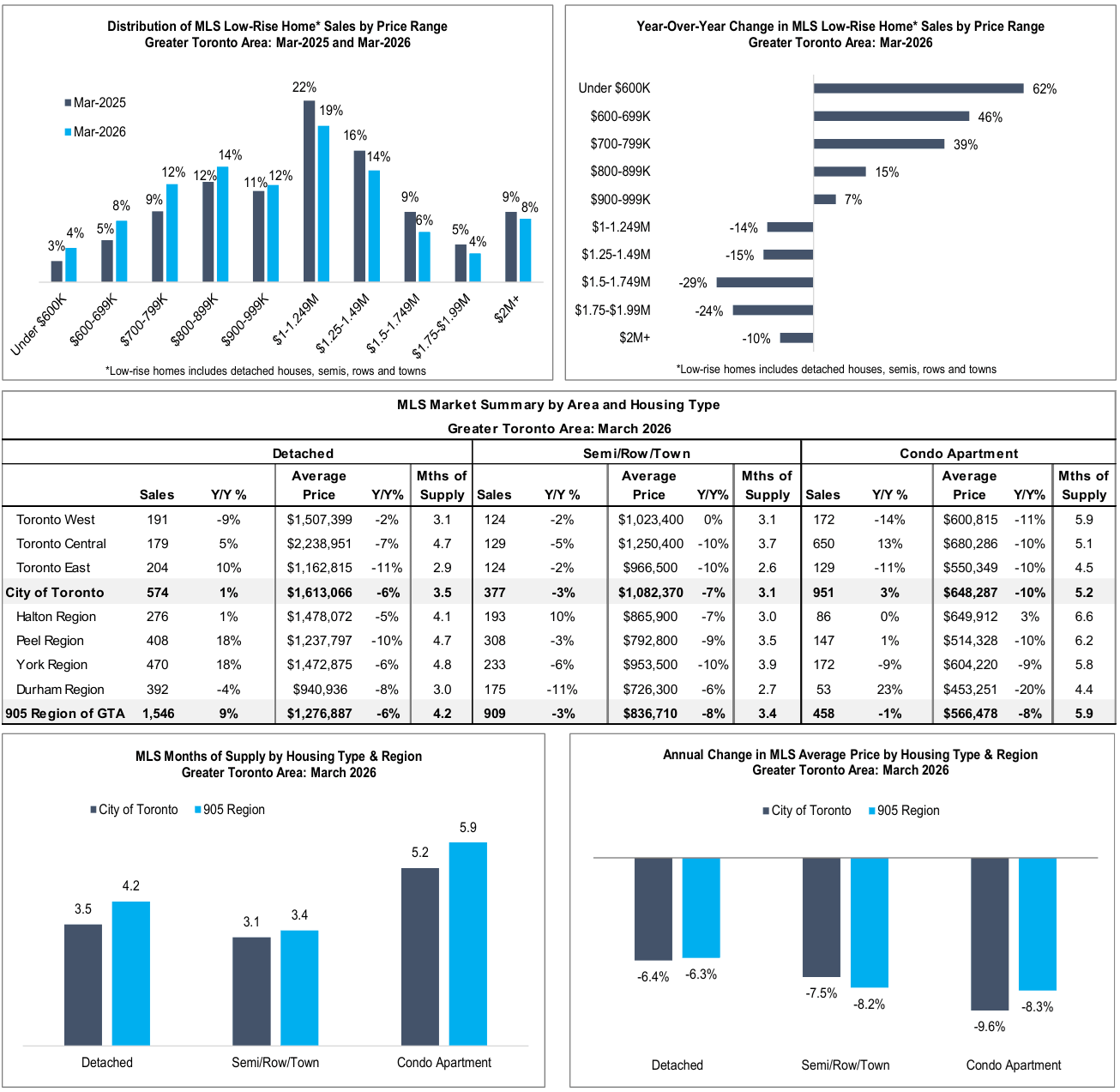
Detached Homes Lead Sales Growth: Detached homes saw a 5% annual increase in sales, while condos edged up 2%. Semis, rows, and towns decreased by 4%. All segments remain significantly below 10-year averages.
Condo New Listings Fall: Condo new listings fell 19% annually, marking the seventh straight month of decline. Active listings for condos dropped 12% to 7,673 units but remain 90% higher than the 10-year average.
Supply Levels: Months of supply for condos dropped to 5.4 months. Detached supply fell to 4.2 months, and semis/rows/towns remained steady at 3.4 months.
Price Drops: Condo prices fell 9.1% year-over-year to a seven-year low of $620,479. Detached homes held up best with a 6.4% annual decrease to an average of $1,342,375.
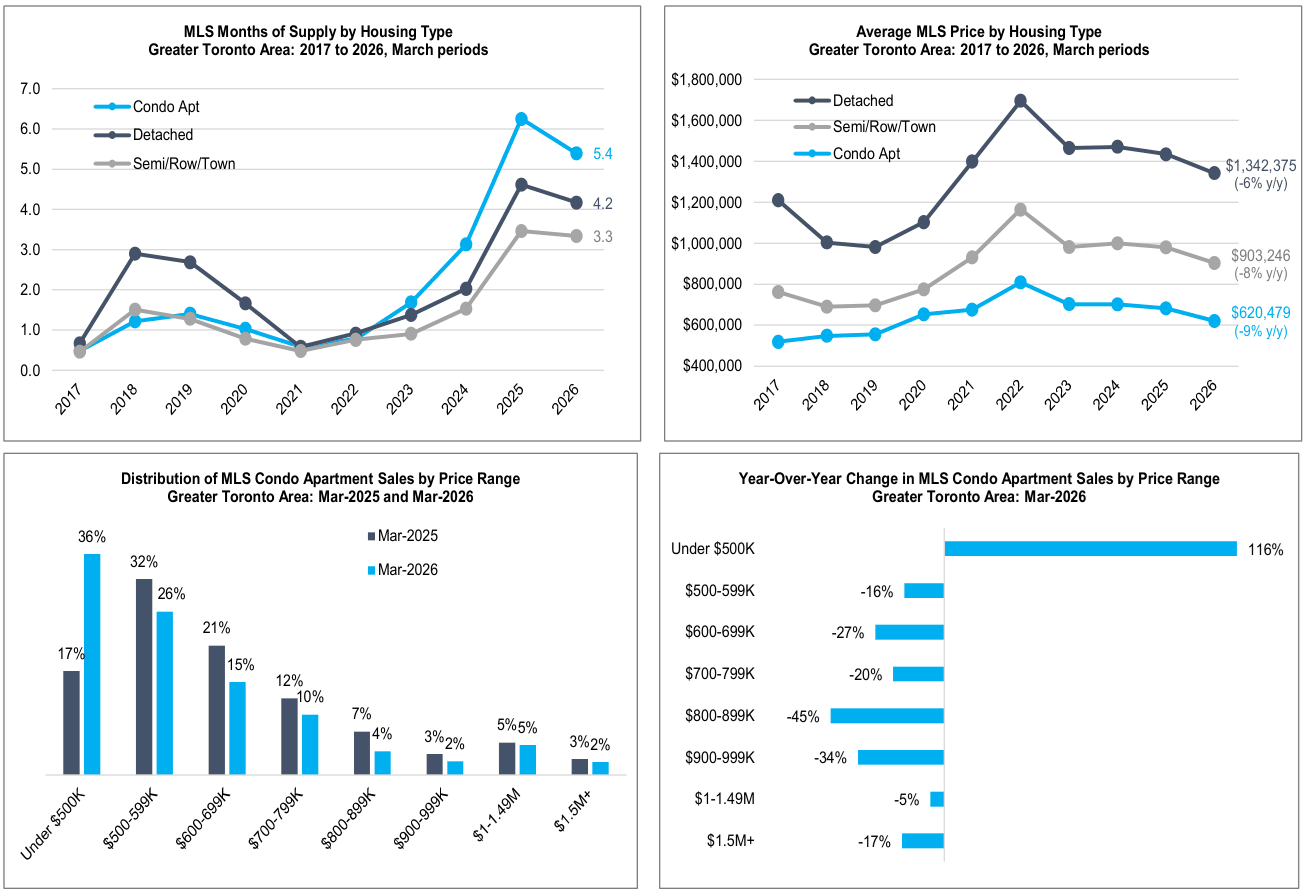
Affordability Shifts: 36% of all condos sold for under $500K, double the share from a year ago. For low-rise homes, sales increased for properties priced under $1 million.
Regional Strength: Detached sales rose fastest in the 905 region (Peel and York), while condo sales were strongest in Toronto Central and Durham.
Key Takeaways
Despite consumer confidence readings plunging due to the outbreak of the Iran war, housing sales managed to increase annually for the first time since September. This suggests some improvement in underlying demand, though geopolitical and economic instability is likely to keep sales subdued in the near term.
With five-year government bond yields rising 50 basis points since the war began, fixed-term mortgage rates have moved up. This may motivate buyers to wait for further price reductions.
Market conditions still favor buyers as it will take several months of sales outpacing new listings for prices to stabilize.
Low-rise homes are showing signs of improvement, with certain segments like detached homes in Toronto and Durham returning to a balanced range of roughly four months of supply.
The condo market appears to be turning a corner. Listings are falling as completions move down from their peak. Activity is rising quickly for entry-level units priced under $500K.
The temporary removal of HST for new condo buyers and a 50% reduction in development charges could lower the cost of a new unit by an average of $100K, helping to absorb builder inventory.