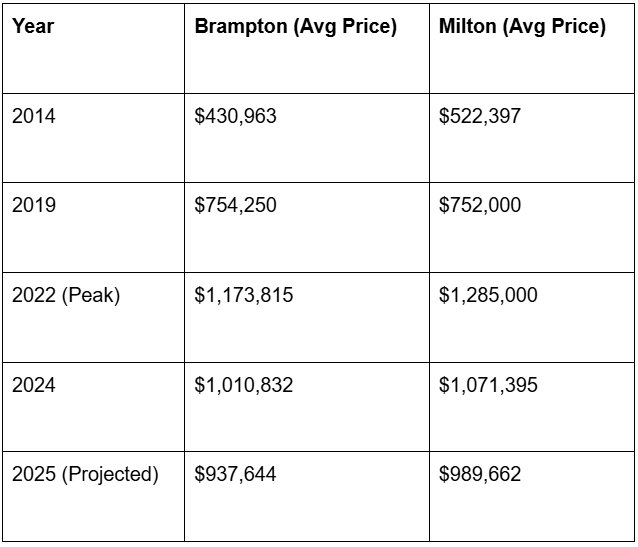
Milton vs. Brampton: A 10-Year Strategic Price Growth Analysis
Strategic Observations
The 19-Year Perspective: Having navigated the 2008 correction and the 2017 Foreign Buyer Tax shift, I see the current price stabilization not as a "loss," but as a return to logistic reality. Milton historically carries a premium over Brampton due to a younger inventory age and tighter school catchment controls.
Inventory Mechanics: Brampton’s market often reacts faster to rate fluctuations due to higher density and investor saturation. Milton’s inventory is more "sticky"—held by families, which leads to slower but more resilient price retention.
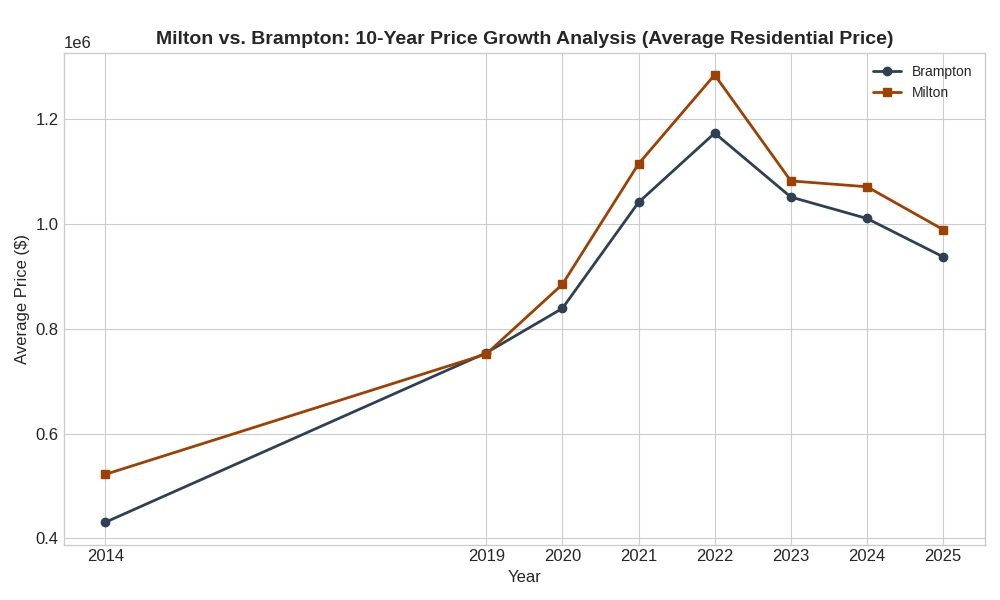
The Velocity Gap: During the 2020-2022 surge, Milton’s prices accelerated by roughly 45% because the demand for detached square footage outweighed the available new-build supply.
The "So What?" for Upsizers
If you are currently feeling "squeezed" in a Toronto or Etobicoke condo, these variables determine your next move:
Lot Value vs. Maintenance: Milton’s newer builds (post-2010) mean lower immediate capital expenditure on mechanics (roof, HVAC, windows). So what? Your monthly cash flow remains predictable as you transition from a maintenance-free condo to a freehold.
Transit Gravity: Both cities offer GO/LRT access, but Milton’s proximity to the 401/407 corridor offers superior logistic flexibility for dual-income households commuting to different hubs. So what? Resale value is protected by a broader buyer pool.
The "Here to Home" Window: We are currently in a price-to-value gap where Milton is trading below its 2022 peak. So what? This is the strategic entry point to deploy your city equity before the next rate cycle triggers a contraction in inventory.
When moving from a "squeezed" Toronto or Etobicoke condo to the suburbs, most buyers look at aesthetic features. After 19 years in the GTA market, I look at the mechanics. Comparing Milton and Brampton isn't about which city is "nicer"—it’s about which market variables protect your equity over a 5-to-10-year horizon.
The 10-Year Trajectory
Nineteen years in this industry, navigating the 2008 and 2017 shifts, has taught me that inventory age is a primary driver of price resilience.
Milton’s Edge: Newer inventory (post-2010) typically means a lower price-to-maintenance ratio. So what? Your capital remains in the land and structure rather than being bled out by immediate mechanical failures (roofs, HVAC, windows).
Brampton’s Volume: Brampton is a high-velocity market with significant investor saturation. So what? This leads to higher volatility during interest rate cycles, offering potential "buy-low" opportunities for those with the liquidity to move fast.
The "Here to Home" Perspective
Using my 5-step framework, we don't just find a house; we identify a strategic asset.
Inventory Mechanics: Assessing lot value vs. square footage.
Transit Gravity: Calculating the GO/LRT proximity for dual-commute households.
School Catchments: Evaluating how localized boundaries drive long-term resale value.
Milton vs. Brampton: Price Growth Analysis (2014–2025)
The chart below illustrates the average residential sale price across all home types.