
GTA Real Estate Market Report: February 2026 | Q Real Estate Group
The Big Picture: A Market Recalibrating, Not Collapsing
The Greater Toronto Area housing market entered February 2026 in a state of deliberate pause. Sales are down, prices are softer, and buyers and sellers alike are watching the same headlines — tariff uncertainty, interest rate trajectories, and a labour market showing early signs of strain. But beneath that surface-level caution, something structurally important is unfolding: new listings are falling faster than sales, and more than 100,000 qualified buyers are sitting on the sidelines waiting for the right moment.
That's not a broken market. That's a coiled spring.
Here is a clear-eyed breakdown of what February 2026 TRREB data shows — and what it means if you're a buyer, seller, or investor in the GTA.
GTA-Wide Statistics: February 2026
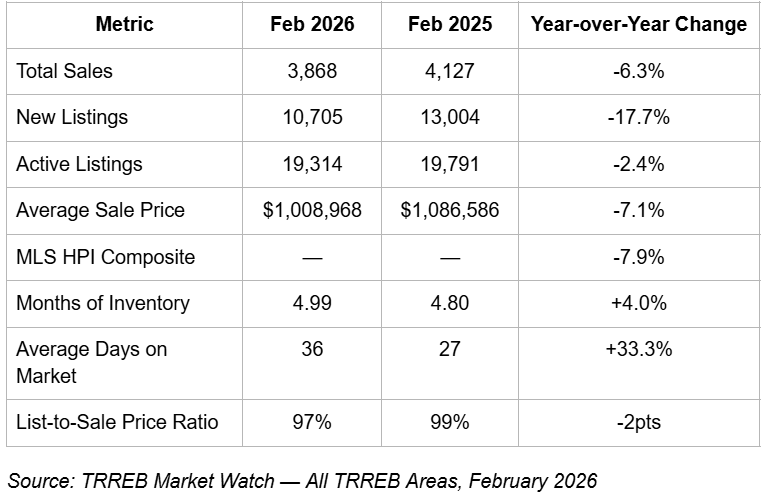
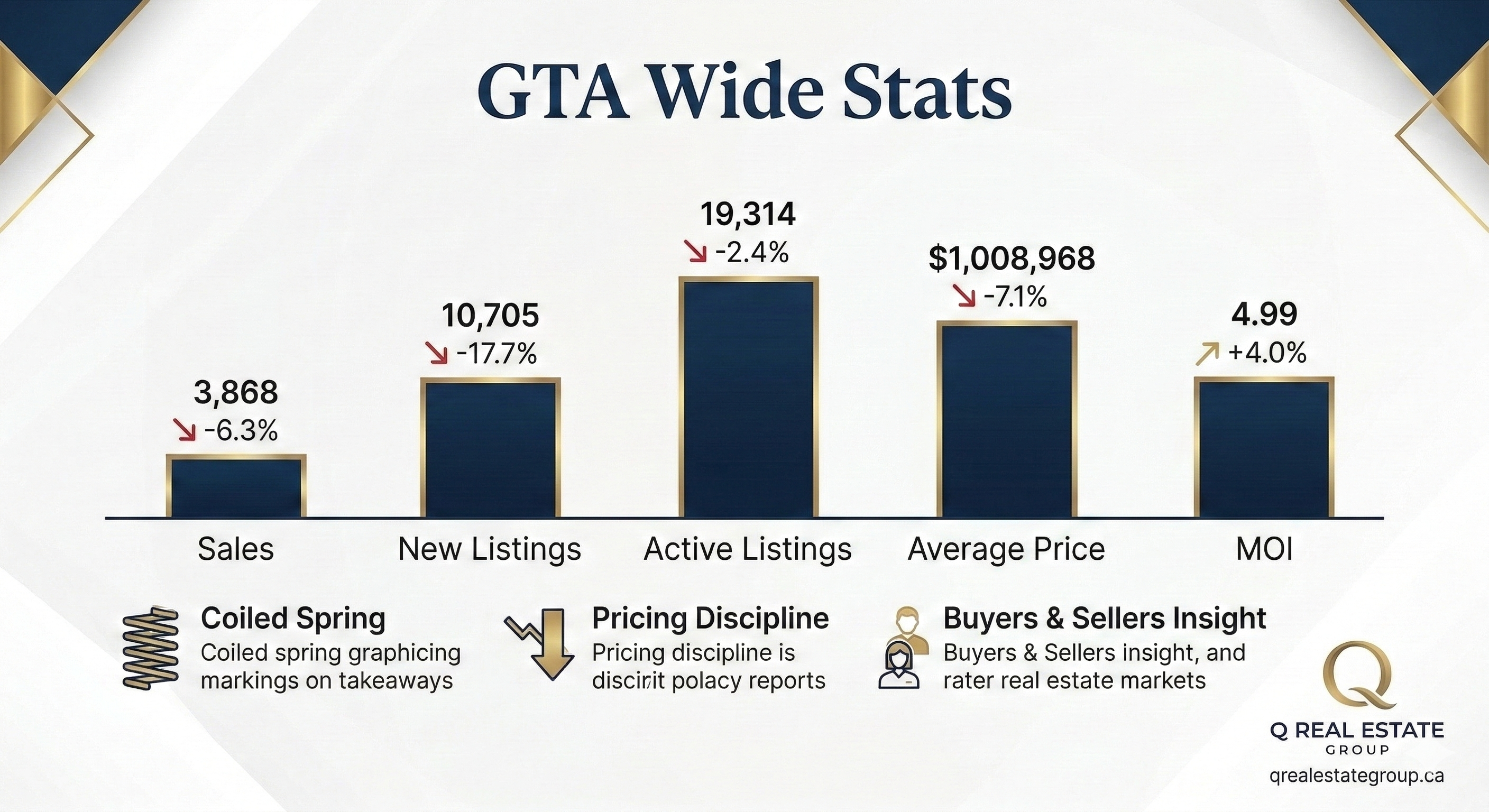
The headline figures show a market that is slower, more deliberate, and more price-sensitive than a year ago. But the most important data point is one that often gets buried: new listings fell nearly three times faster than sales. That gap is the critical variable shaping the spring market.
As TRREB President Daniel Steinfeld noted, "If new listings continue to trend lower through the spring, competition between homebuyers will increase, supporting home prices and a recovery in sales."
Historical Comparison: Putting February 2026 in Context
Looking back across six years of February data reveals just how dramatically the market has shifted since the pandemic peak:
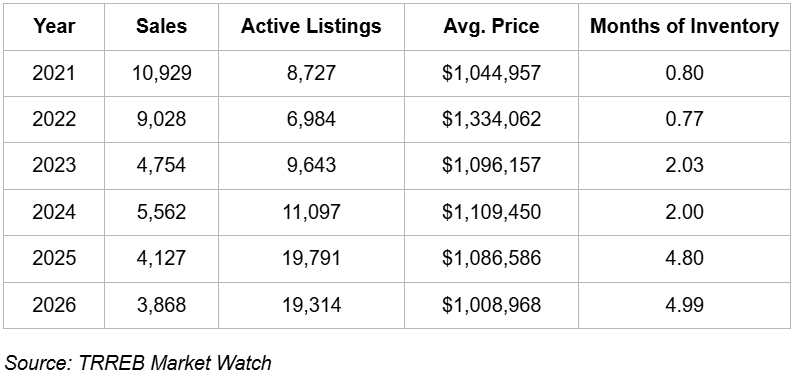
The 2022 peak — $1.334M average, 0.77 months of inventory — now looks like an outlier rather than a baseline. Average prices today are actually close to where they were in early 2021, before the pandemic surge. From a long-cycle perspective, the market has undergone a significant correction. Whether you call this the bottom or a plateau will depend heavily on what happens with trade policy and Bank of Canada rate decisions in the months ahead.
Bank of Canada Rate Context
The Bank of Canada's overnight rate currently sits at 2.25%, down sharply from the 5.00% peak reached in mid-2023 and held through much of 2024. Despite that material reduction in borrowing costs, demand has not rebounded proportionally — partly because prices remain elevated relative to incomes, and partly because economic uncertainty tied to U.S.-Canada trade tensions is suppressing consumer confidence.
The correlation between rate cuts and price recovery has been weaker than many expected, a reminder that affordability is a multi-variable equation, not just a function of the overnight rate.
City of Toronto: Volume Down, But Relative Resilience
February 2026 — Toronto Area Stats (Year to Date)
Average Sale Price (YTD): $989,346 (-5.0% year-over-year)
Number of Sales (YTD): 2,562 (-13.1%)
Average Days on Market: 40 days (+17.6%)
Months of Inventory: 4.96
February Sales (416): 1,491 (-3.2%)
February Active Listings (416): 7,397 (-5.3%)
February Avg. Price (416): $1,019,144 (-6.2%)
Condo Corner — Toronto:
Average Condo Sale Price: $663,984 (-8.4%)
Condo Sales: 733 (-11.7%)
Active Condo Listings (416): 4,529
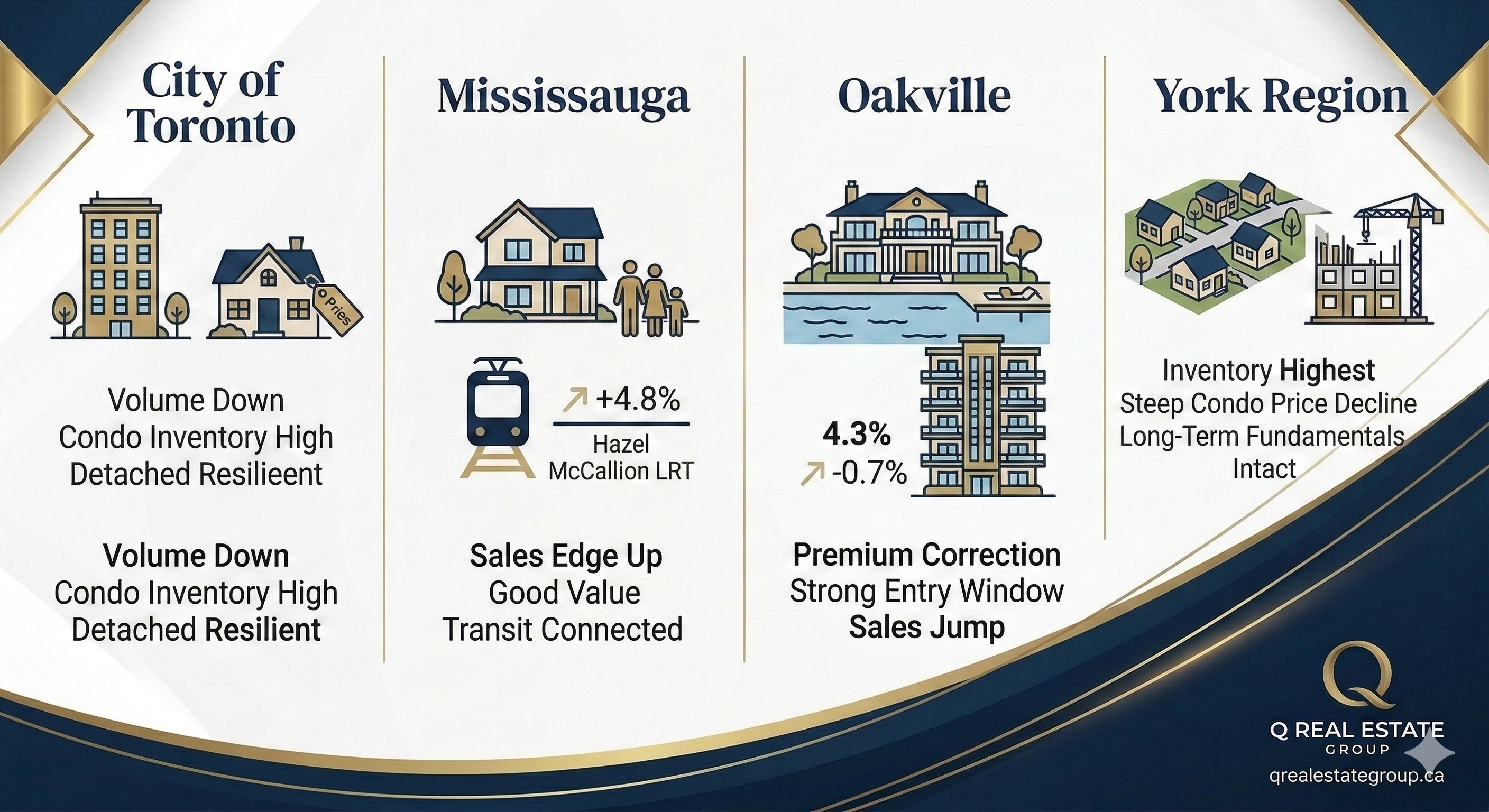
The City of Toronto tells a nuanced story. Sales are down, but notably, detached home sales in the 416 area actually rose 3.6% year-over-year — suggesting that lower prices are drawing some buyers back into the freehold market. Condos, however, remain under significant pressure. With 4,529 active listings against only 733 sales, the Toronto condo segment is firmly a buyer's market with approximately 6+ months of supply in that category alone.
Townhouse sales in the 416 also ticked up 2.7%, a signal that well-priced, move-in-ready urban homes in the mid-range are still attracting motivated buyers.
For sellers in Toronto: Pricing discipline is non-negotiable. The 97% list-to-sale ratio means overpriced listings are sitting. Homes priced at market are transacting, but the premium of 2021-2022 is not coming back in the near term.
For buyers in Toronto: The condo market offers the most negotiating leverage the city has seen in years. Buyers with stable financing who act before potential spring competition builds have a real window.
Mississauga: Sales Edge Up, Prices Remain Soft
February 2026 — Mississauga Area Stats (Year to Date)
Average Sale Price (YTD): $953,840 (-8.4% year-over-year)
Number of Sales (YTD): 644 (-6.0%)
Average Days on Market: 40 days (+17.6%)
Months of Inventory: 5.07
February Sales: 345 (+3.6%)
February Active Listings: 1,748 (+3.1%)
February Avg. Price: $963,747 (-7.3%)
Condo Corner — Mississauga:
Average Condo Sale Price: $514,936 (-11.4%)
Condo Sales: 96 (-5.0%)
Mississauga stands out as one of the few GTA sub-markets where monthly sales actually rose — up 3.6% in February compared to the prior year. This is a meaningful signal. Buyers are returning to Mississauga, drawn by relative value compared to Toronto proper and the area's established infrastructure, transit connectivity, and employment base.
The average price has dipped below $1M on a YTD basis for the first time in several years, which opens up the market to a wider pool of buyers who were previously priced out. Condo prices at $514,936 are approaching pre-pandemic levels in some product categories.
For sellers in Mississauga: The uptick in sales suggests demand is present when pricing is competitive. Overpriced homes are being bypassed; realistically priced ones are moving.
For buyers in Mississauga: This is one of the stronger value propositions in the GTA right now, particularly for families and first-time buyers who need square footage and access to Pearson corridor employment.
For investors in Mississauga: The sub-$550K condo price point and improving transit infrastructure (Hazel McCallion LRT) make this market worth watching for long-term hold strategies, despite near-term rental market softness.
Oakville: Premium Market Feels the Correction, But Demand Is Returning
February 2026 — Oakville Area Stats (Year to Date)
Average Sale Price (YTD): $1,327,632 (-8.2% year-over-year)
Number of Sales (YTD): 261 (-9.4%)
Average Days on Market: 39 days (+25.8%)
Months of Inventory: 5.72
February Sales: 156 (+9.1%)
February Active Listings: 892 (-5.6%)
February Avg. Price: $1,325,983 (-11.9%)
Condo Corner — Oakville:
Average Condo Sale Price: $600,115 (-10.7%)
Condo Sales: 34 (+61.9% — from a low base of 21)
Oakville's market contains a striking data point: February sales rose 9.1% year-over-year, even as prices remain down nearly 12%. This reflects a market where serious buyers are acting on genuine value — the average Oakville home is now approximately $175,000 less expensive than it was at its peak, which is a material number in an absolute sense.
The condo segment's 61.9% sales jump (from 21 to 34 units) should be read carefully — small base effects can amplify percentages — but directionally, it suggests the lower end of Oakville's market is seeing renewed interest, particularly as buyers get priced out of freehold product.
Active listings are actually down 5.6% year-over-year in February, which means the inventory build has begun to stabilize. If that trend continues into spring, Oakville could see meaningful price support by mid-year.
For sellers in Oakville: The correction has been significant. Sellers who purchased pre-2021 retain substantial equity. Those who purchased at or near peak (2021-2022) face real challenges if they need to sell now. Timing and presentation matter more than ever.
For buyers in Oakville: This is among the best entry windows the Oakville market has offered since 2019. Buyers in the $1.2M–$1.5M freehold range have negotiating power that hasn't existed in this market for years.
York Region: Inventory High, Prices Under Pressure
February 2026 — York Region Stats (Year to Date)
Average Sale Price (YTD): $1,122,835 (-8.7% year-over-year)
Number of Sales (YTD): 1,234 (-9.7%)
Average Days on Market: 42 days (+31.3%)
Months of Inventory: 5.42
February Sales: 683 (-7.3%)
February Active Listings: 3,704 (+1.6%)
February Avg. Price: $1,133,471 (-9.0%)
Condo Corner — York Region:
Average Condo Sale Price: $571,250 (-13.2%)
Condo Sales: 144 (-11.1%)
York Region — encompassing Richmond Hill, Vaughan, Markham, Aurora, Newmarket, and King Township — is carrying the most visible signs of the broader market correction. With 5.42 months of inventory and average days on market stretching to 42 days, this is a market where sellers must be patient and buyers have leverage.
The 13.2% year-over-year decline in condo prices is the steepest in the comparative data examined, reflecting both oversupply in new construction delivery and softening rental demand following the pullback in non-permanent residents and international students in Ontario.
The York Region market's longer-term fundamentals — proximity to employment nodes along Highway 400/404 corridors, strong school districts, and established communities — remain intact. But the near-term requires price realism.
For sellers in York Region: At 42 average days on market, sellers need to calibrate expectations around time-on-market. Pricing at or slightly below comparable sales is the strategic play in this environment. Holding out for peak prices risks extended carrying costs.
For buyers in York Region: The combination of softer prices, elevated inventory, and a motivated seller pool makes this one of the more favourable buyer environments in the GTA. Buyers with financing in order can negotiate meaningfully.
For investors in York Region: The rental market correction from peak non-permanent resident levels creates near-term cash flow challenges. Investors should model conservatively and focus on properties with strong long-term demographic demand rather than speculative appreciation.
Burlington: Halton Region Context
Burlington sits within Halton Region alongside Oakville, Milton, and Halton Hills. While Burlington-specific February data is not broken out separately in this TRREB report, the Halton Regional data indicates comparable directional trends to Oakville — with prices softer year-over-year and inventory elevated relative to the 2021-2022 period, but with early signs of demand stabilization as prices become more accessible.
Burlington's relative affordability compared to Oakville, combined with strong GO Transit connectivity to downtown Toronto and a mature residential community, continues to attract families and remote workers seeking value in the western GTA corridor.
YTD Average Sales Price: The Big Picture
GTA Year-to-Date Average Sales Price — February 2026
GTA Overall: $992,965 (-6.7% vs. 2025, -1.2% vs. 2024)
GTA Condo Average: $626,650 (-8.9%)
Condo Sales: 1,088 (-11.2%)
The GTA-wide YTD average price of $992,965 is meaningful — it represents the first time since 2020 that the rolling average has dipped below $1M. Compared to the YTD peak in 2022 ($1,303,500), current prices represent a 23.8% decline in nominal terms. Factor in inflation over that period and the real price correction is even more pronounced.
What This Means: Strategic Guidance by Participant Type
For Buyers
This is the most favourable buying environment since 2019 by most measurable metrics — more selection, more negotiating power, and prices that have corrected materially from peak. The risk is not overpaying; the risk is waiting too long. TRREB's data shows more than 100,000 buyers are currently holding off. When they move — and they will move — competition will return quickly.
The strategic play: get pre-approved, identify your market, and be ready to act decisively when the right property surfaces. Waiting for the absolute bottom is a strategy that historically costs buyers more than it saves.
For Sellers
The days of listing a property and receiving multiple bids over asking within 72 hours are not the current reality in most GTA segments. This market requires preparation, accurate pricing, and professional presentation. The list-to-sale ratio of 97% tells you that the market is transacting — but only for properties priced at market. Overpriced listings are accumulating days on market and conditioning buyers to expect a price reduction.
If you are selling in 2026, the strategic approach is to price correctly from day one, invest in presentation, and work with an agent who understands the current comparable landscape. Sellers who adjust their expectations to the current market — rather than the 2022 market — are still achieving strong outcomes.
For Investors
The condo segment requires the most caution. Between declining rents (tied to the pullback in non-permanent residents), elevated supply in new construction delivery, and negative year-over-year price movement ranging from 8.4% to 13.2% depending on the area, cash flow models that worked in 2021-2023 may not pencil today.
Freehold investment properties with strong tenant demand, located near transit nodes and employment centres, remain more defensible. The medium-term thesis for GTA real estate — population growth, constrained land supply, underbuilding relative to demand — remains structurally intact. But near-term, investors should stress-test their assumptions and carry costs against a scenario where prices remain flat or softer through 2026.
What to Watch in the Coming Months
Several variables will determine whether the spring 2026 market recovers or remains subdued:
Bank of Canada rate decisions — Further cuts would improve affordability and could unlock some of the 100,000+ buyers currently sitting out. The current rate of 2.25% is already significantly accommodative.
U.S.-Canada trade developments — TRREB's Jason Mercer specifically cited "positive news on the trade front" as a prerequisite for buyer confidence to return. This is a wildcard that no real estate analysis can predict with certainty.
New listing volumes — If sellers continue to hold back (as Ipsos polling data suggests), the supply-demand imbalance will tighten, providing price support even with current demand levels. If listings surge in spring, prices face renewed downward pressure.
Employment data — Consumer willingness to commit to a $1M+ purchase is tightly correlated with job market confidence. GTA employment trends will be a key leading indicator.
Conclusion
February 2026's GTA real estate data reflects a market in transition, not collapse. Prices have corrected, sales volumes are below recent norms, and caution is the dominant sentiment. But the structural conditions for a market recovery — pent-up demand, declining new listings, interest rates well below recent peaks — are quietly building.
The participants who navigate this market most successfully will be those who make decisions based on data and long-term fundamentals, not short-term noise. Whether you are buying, selling, or investing, the market of February 2026 offers real opportunities — provided you approach it with clear eyes and a sound strategy.
Data sourced from TRREB Market Watch, All TRREB Areas, February 2026. Year-to-date figures represent January–February 2026. This report is prepared by Royal LePage Signature Realty and is intended for informational purposes. Not intended to solicit those currently under contract with another brokerage.