
Calgary Housing Market Update: June 2026 Stats
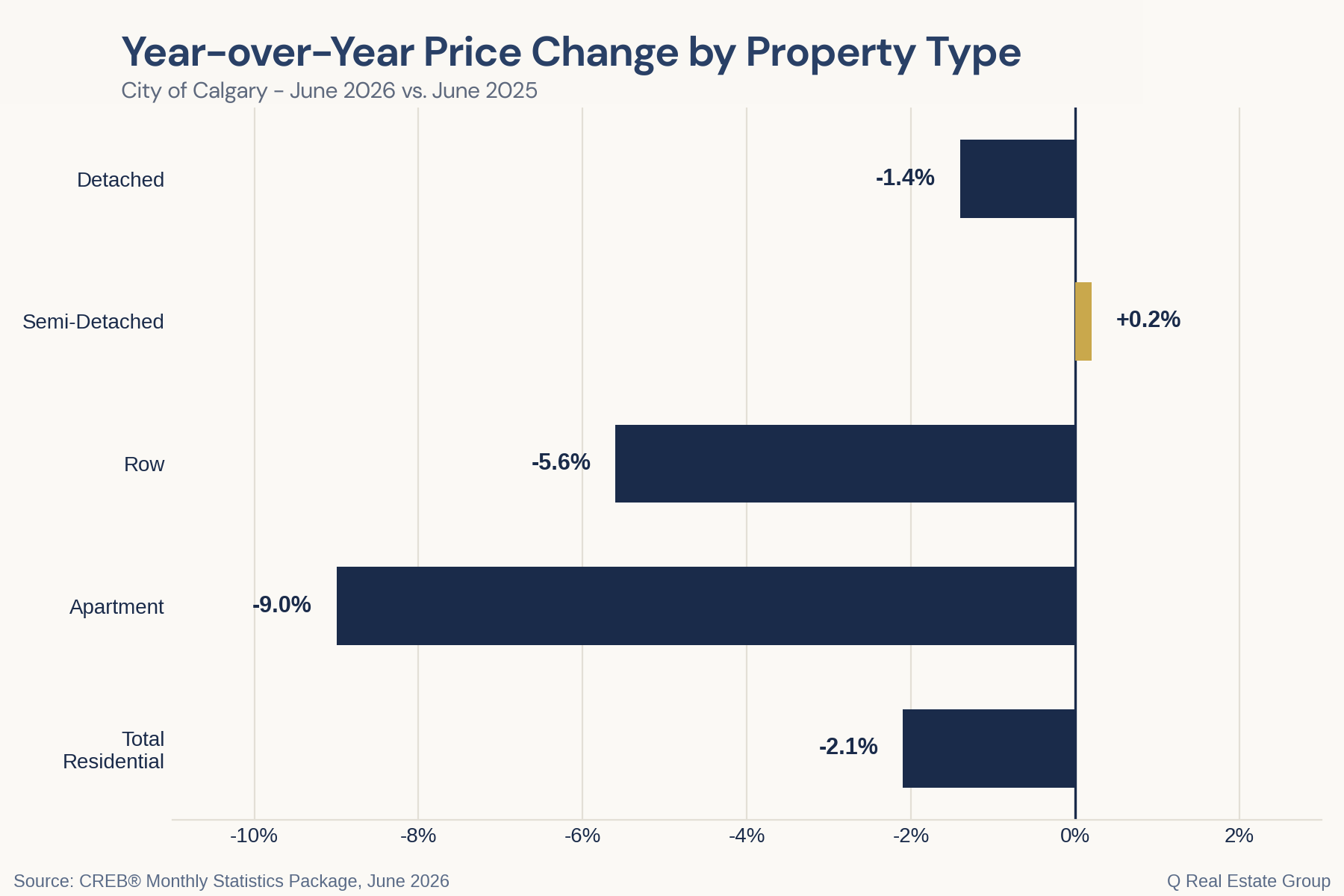
Calgary home sales reached 2,197 units in June 2026, down 3.8 percent year over year, while the total residential benchmark price eased to $572,500, a 2.1 percent annual decline. Apartment condo prices fell 8.95 percent — the steepest drop of any property type — as new high-density supply outpaces demand. Detached and semi-detached prices held far closer to last year's levels, and one district, the West, actually posted a price gain. Here is what the June numbers show, property type by property type and region by region, and what they mean if you are buying or selling in Calgary.
All figures are from the CREB® Monthly Statistics Package, City of Calgary and Calgary Region, June 2026.
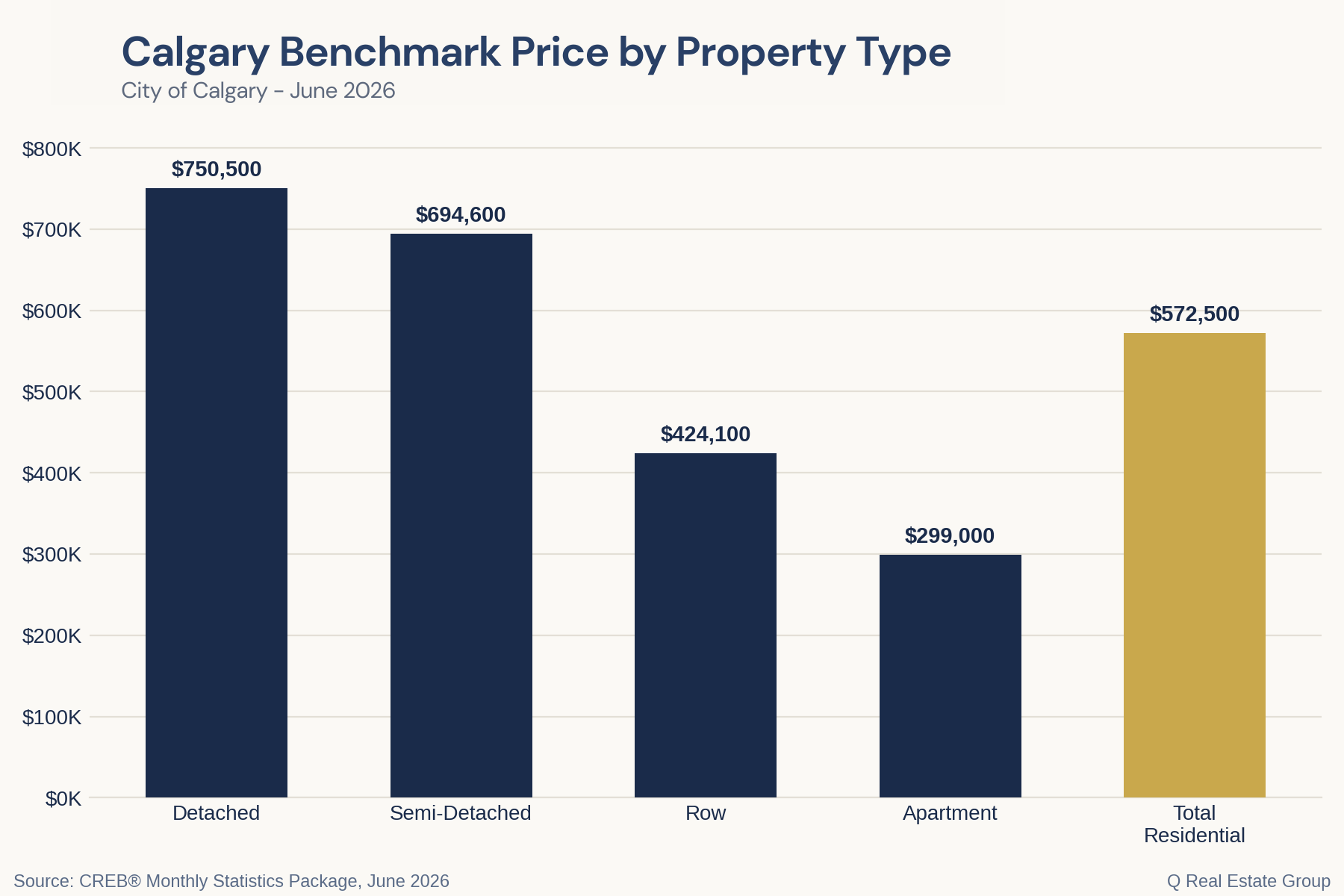
The headline number: a widening gap between condos and everything else
The story of the month is supply, not demand. Calgary has worked through several consecutive years of record-high housing starts, and that new construction has landed disproportionately in high-density, condo-style product. Inventory growth has been concentrated there while resale and new-home supply for ground-oriented housing has stayed comparatively tight.
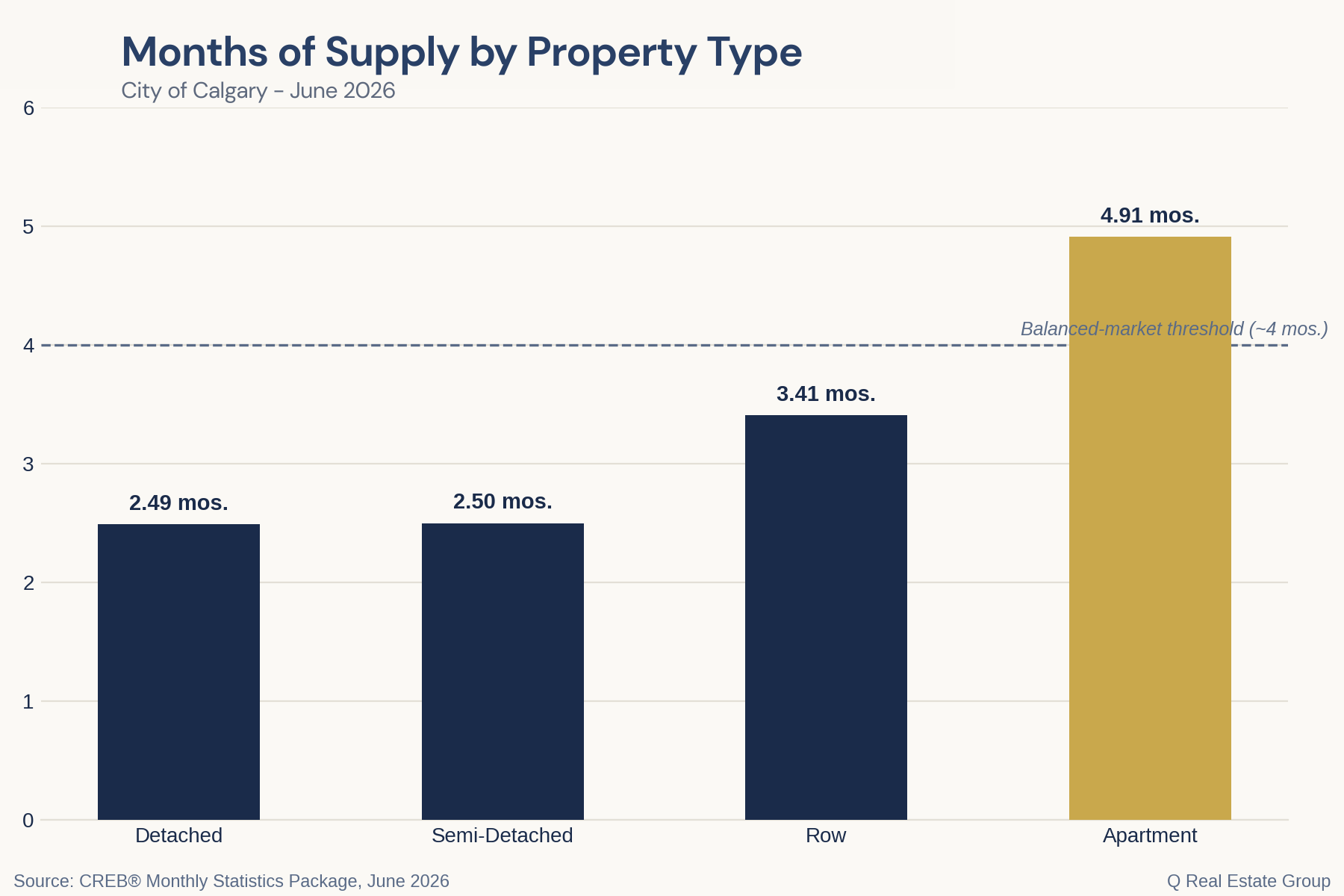
The result: months of supply for apartments sits at 4.91, up 23.3 percent from last June, with a sales-to-new-listings ratio of just 45 percent — solidly buyer's market territory. Detached homes, by contrast, sit at 2.49 months of supply with a 60 percent sales-to-new-listings ratio, which is a much more balanced condition.
Price and sales by property type
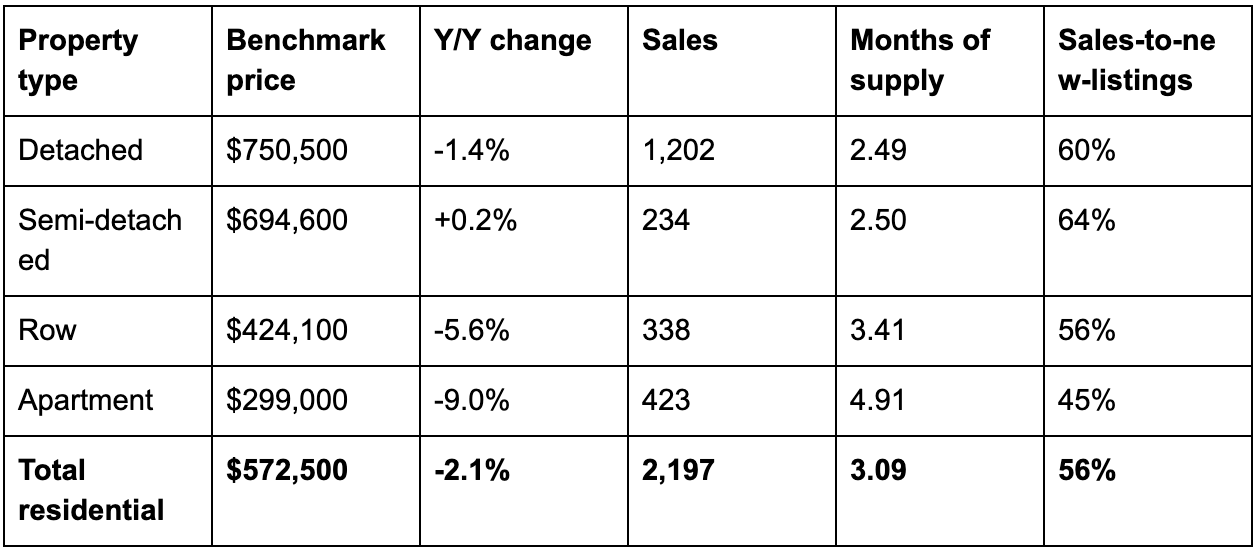
Semi-detached is the only property type to post a year-over-year price gain, and it is also seeing the fastest pace of sales relative to new listings. Row homes and apartments, the two most supply-heavy categories, are where the price softening is concentrated.
Where the money moved: district-level highlights
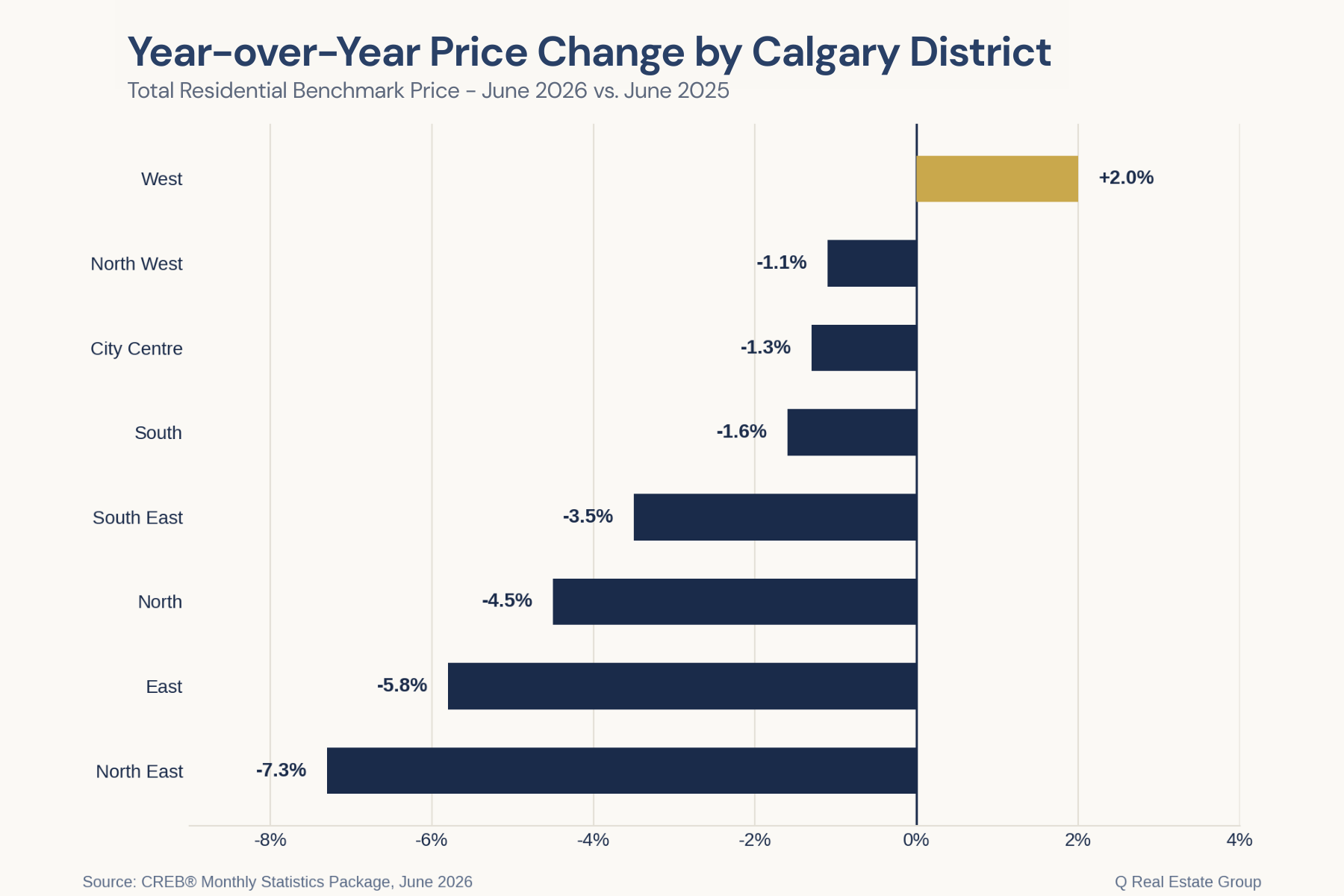
Calgary's eight districts are not moving in unison. Total residential benchmark prices ranged from a 2.0 percent gain in the West to a 7.3 percent decline in the North East.
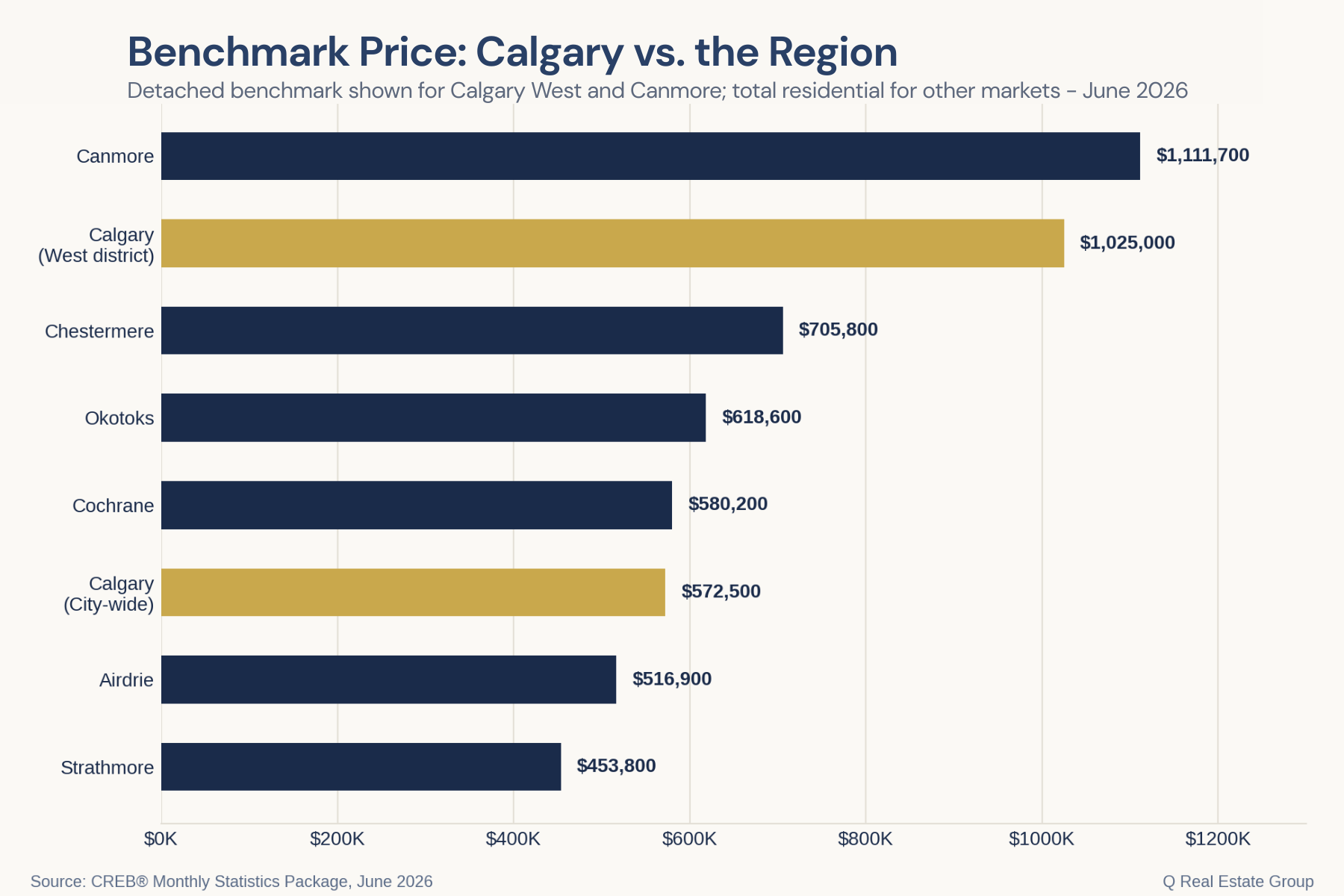
West — the only district with a year-over-year price increase (+2.0%), driven by detached homes reaching a new record benchmark of $1,025,000, up 3.72 percent.
City Centre — total residential price down just 1.3 percent, with detached actually up 1.06 percent to $996,800. Apartments here fell 8.86 percent.
North East — the softest detached market, down 6.80 percent to $560,700, with overall residential prices down 7.3 percent, the largest decline citywide.
East — home to the steepest apartment price decline of any district, down 15.42 percent year over year.
The pattern holds across the city: wherever condo supply is heaviest relative to demand, prices have adjusted the most. Wherever detached and semi-detached stock stayed tight, prices have held or even climbed.
Beyond city limits: how the surrounding region compares
Calgary's price story is not the whole region's story. Some nearby markets are tightening even as the city loosens.
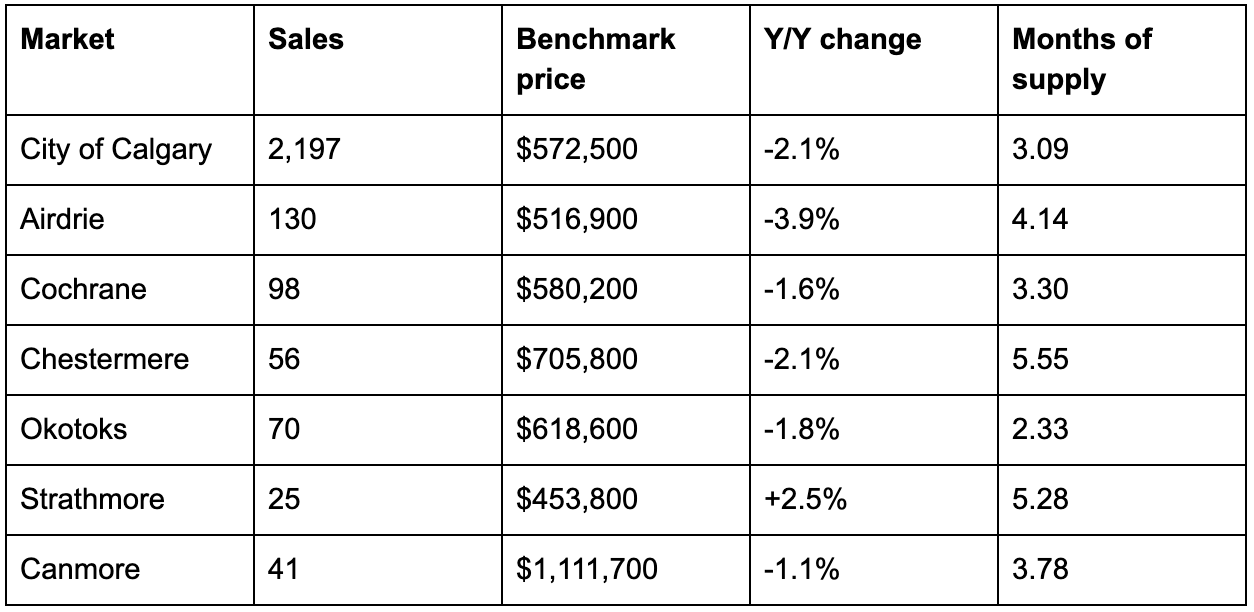
Strathmore stands out as the one community in this set with a year-over-year price gain, alongside a 31.6 percent jump in monthly sales and a 15.7 percent increase in year-to-date sales — a market clearly gaining momentum. Airdrie and Chestermere, on the other hand, both carry rising inventory and softening prices, giving buyers more room to negotiate than they have had in some time.
What this means for sellers
Pricing strategy now depends heavily on property type and location, more than it has in recent months. Detached and semi-detached sellers, particularly in the West and City Centre, are working in genuinely balanced-to-tight conditions — homes are still moving at a healthy pace relative to what comes to market. Semi-detached sellers city-wide are in the strongest position of any property type, with prices up slightly and the fastest sales-to-new-listings ratio.
Apartment and row-home sellers face a different reality. With close to five months of supply and a 45 percent sales-to-new-listings ratio for condos, buyers have real choice and are not under pressure to compete. Pricing accurately from listing day one, and being realistic about how new supply in the area is shaping buyer expectations, matters more here than in the detached market. Sellers in the North East and East districts, where price declines have been steepest, should expect the most price-sensitive negotiations.
What this means for buyers
Condo buyers have the most leverage they have had in years. With nearly five months of supply and prices down almost 9 percent year over year, there is real room to negotiate on price, closing timelines, or conditions — particularly in the North East and East districts, where declines have been sharpest.
Detached buyers face tighter competition, especially in the West, where prices hit a new record this month, and in City Centre, where detached homes are still appreciating. Buyers focused on those areas should be prepared to move decisively on well-priced listings.
For buyers open to looking beyond city limits, Airdrie and Chestermere currently offer more selection and softer pricing than a year ago, while Strathmore and Cochrane are showing early signs of tightening — worth watching if you are weighing location against timing.
Frequently asked questions
What is the benchmark price for a home in Calgary in June 2026? The total residential benchmark price in the City of Calgary was $572,500 in June 2026, down 2.1 percent from June 2025.
Are Calgary condo prices dropping? Yes. The apartment benchmark price fell 8.95 percent year over year to $299,000, the largest decline of any property type, driven by a surge in high-density supply.
Is it a buyer's market or seller's market in Calgary right now? Overall, the city is close to balanced at 3.09 months of supply. Conditions vary sharply by property type: detached and semi-detached homes remain in more balanced-to-tight territory, while apartments are firmly in buyer's market conditions at 4.91 months of supply.
Which Calgary-area communities have rising home prices? The West district within Calgary and the town of Strathmore both posted year-over-year price gains in June 2026. Most other districts and surrounding communities saw modest declines.
How many months of supply does Calgary have? Calgary had 3.09 months of supply city-wide in June 2026, up 1.8 percent from a year earlier. This varies by property type, from 2.49 months for detached homes to 4.91 months for apartments.
If you would like a closer look at what these numbers mean for your specific neighbourhood, property type, or plans, I am happy to walk through the data with you. Reach out anytime.